
Since 2020, experiments with biochar have been conducted within the Fifata group of farmer organizations (FOs) in Madagascar in order to make use of abundant local biomass, particularly rice husks, and to improve soil fertility using agroecological methods. This work, initiated and structured by Ceffel with the support of Fert, has gradually attracted the interest of many farmers, leading to the growing spread of the practice in several regions of the Highlands of Madagascar, Vakinankaratra, Haute Matsiatra, Analamanga, and Itasy.
However, biochar remains an emerging technology, whose effects, production conditions, and methods of use vary greatly depending on the context. In order to avoid uncontrolled adoption and lay the foundations for sustainable deployment, an in-depth study was conducted in 2025 to capitalize on existing experiences, analyze practices, and identify the conditions for success within the Fifata group’s farmers’ organizations.


What is biochar ?

Biochar is a stable plant-based charcoal obtained by pyrolysis of biomass (agricultural, forestry, or organic waste) heated to high temperatures in the absence or low presence of oxygen. Unlike coal intended for combustion, biochar is used as a soil amendment. Its porous structure gives it a high capacity for retaining water and nutrients, promoting soil biological activity and long-term carbon sequestration. Biochars made from rice husks are known as sichars.
They have specific properties, including a supply of bioavailable silicon, which helps to strengthen crops’ resistance to biotic and abiotic stress, while improving the physical and chemical properties of the soil.
Ceffel at the heart of early experiments

From production to utilisation
Group Fifata’s Key figures
-
16 pyrolyzers in operation
-
~80 kg of biochar produced per pyrolysis cycle
-
~15 t of biochar / year / pyrolyzer
-
Supply cost per pyrolyzer : ~3.1 million Ar/year
Conducted in 2025, the study is based on a capitalization approach combining field surveys, interviews, visits to production sites, and analysis of existing experiments. It involved a diverse range of stakeholders: experimental farmers and lead farmers, local agricultural advisors (CAP), heads of regional farmers’ organizations, and Ceffel technicians. This multi-stakeholder approach made it possible to jointly analyze the technical, agronomic, economic, organizational, and environmental dimensions related to the production and use of biochar.
The results show that practices have developed gradually, starting with pioneering initiatives that have subsequently spread within groups.
Pyrolysis methods rely on simple artisanal devices, often shared among groups, revealing both a strong capacity for local innovation and persistent constraints in terms of time, labor intensity, and production regularity. The biochars produced are then stabilized before use, with liquid manure prepared from organic matter recovered or produced on the farm.
Encouraging agronomic results
The farmers interviewed repeatedly reported improvements in soil structure, better water management, and easier soil cultivation. Yield increases and improved production quality were observed in certain vegetable crops and potatoes, which are prioritized for biochar use. Several farmers also report a reduction in attacks by certain pests, as well as a partial reduction in the use of mineral fertilizers and synthetic pesticides.
Nevertheless, the effects remain variable depending on soil and climate conditions, crops, application rates, and combinations with other organic amendments. There is still insufficient data to draw definitive conclusions, highlighting the need to continue trials over several crop cycles.
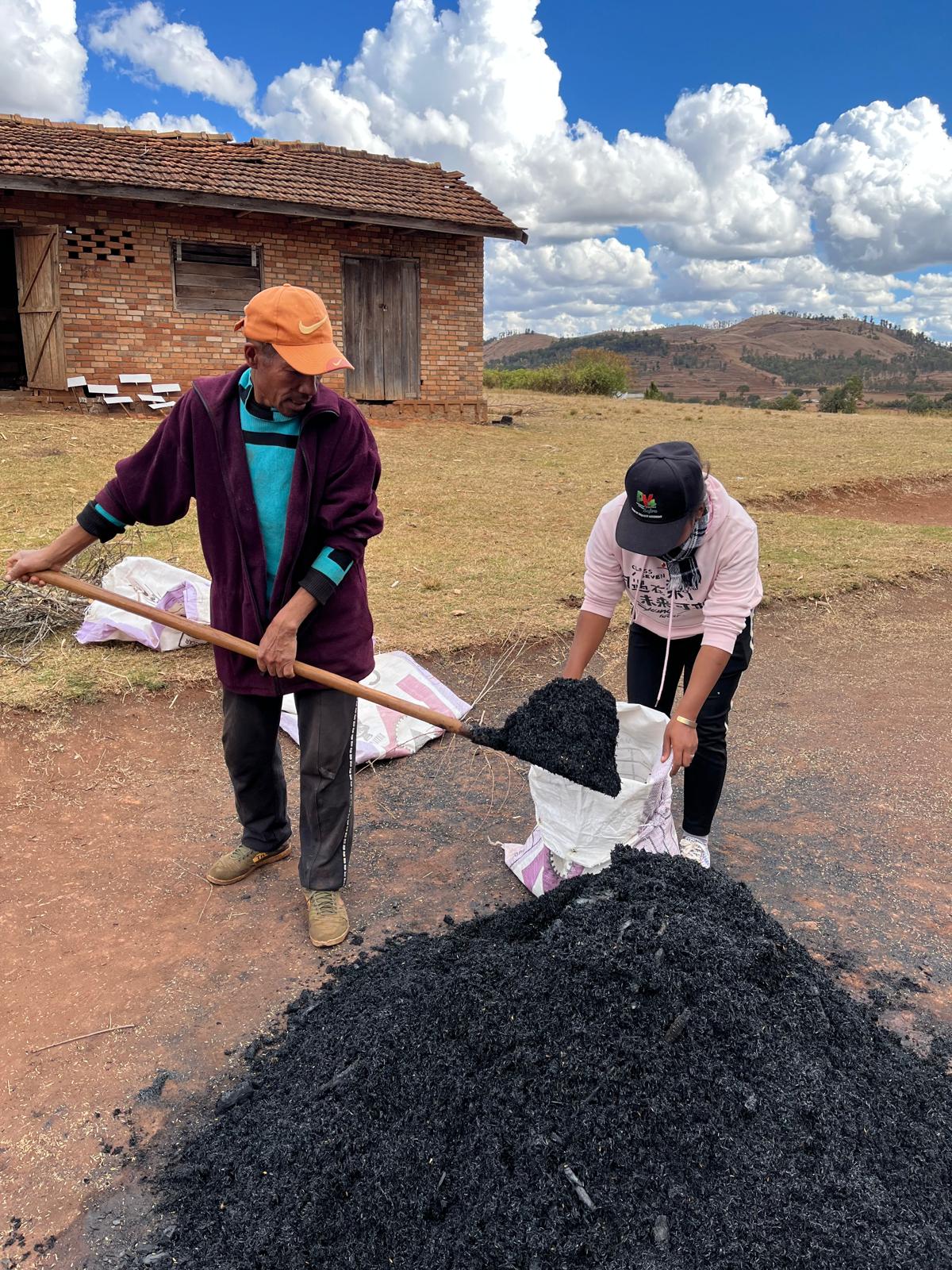
Training and support to promote innovation
The study highlights that the sustainable adoption of biochar relies heavily on technical support, ongoing training, and peer learning within farmer organizations. FOs play a key role in pooling equipment, disseminating knowledge, and securing practices.
In this context, several initiatives are already underway. Laboratory analyses of the biochars produced are being carried out in order to better characterize the materials obtained (composition, stability, agronomic properties) and refine technical recommendations. At the same time, new pyrolysis prototypes are being tested with the aim of improving production conditions, increasing yields, reducing labor intensity, and better meeting the needs of farmers.
This work confirms that biochar is a promising agroecological innovation, provided it is deployed gradually, in a controlled manner, and adapted to local contexts.

